Monday, 16 November 2015

*Wage Peace*, borrowed whole from Philip Carr-Gomm's blog today

Of course, I wanted to add my small voice to the shouting and despair about France, about everywhere.  The despair that terrorists WANT us to feel.  I couldn't think of anything to say.  Except 2 things - that obviously, had I been there I would likely be raging, or made  to feel horribly mental.  I would likely be dead or lost.  I doubt I would have any calm, or perspective, at all. 

Also, that I don't blame the people of Europe for seeming more upset about this than more far away incidents, even though those happen with horrid frequency and many more casualties.  It's normal to identify first with those you reckon are closest and more like you, on the surafce at least.  Those whose homes and areas look so like your own.  That's just human nature.  As long as that then radiates out, soon, to all others and makes us think what we can do to help, to help everywhere...As long we look at the causes, and see where we in the West helped make the circumstances for all this to happen.  Not blameless.  No justification, but clear thinking necessary.

But, from this distance, which is by no means numbing, unlike usual, my reaction this time was not to want vengeance (I am usually a very angry person).  This time - I saw utter dark, and it made me want to hold up a huge light.  Not to ignore, or to be fluffy and rejecting of reality in the face of so much blood and pain and cruelty - but because DESPAIR is a lie, I think it might be the worst reaction we can have. 

Philip Carr-Gomm, from OBOD posted this up today.  I couldn't agree more. I hope he doesn't mind the share - there was no button for it on his blog...

 ***

Wage Peace

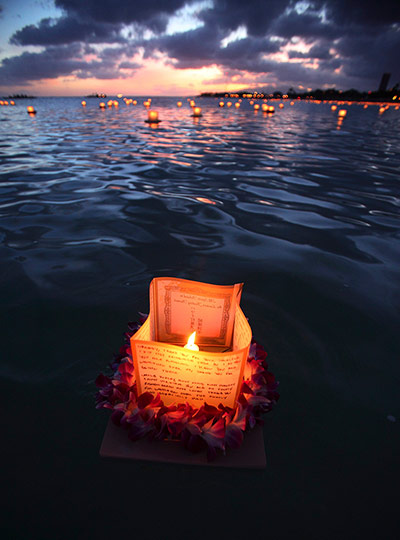
Honolulu, Hawaii: A lantern draped with a flower lei floats on the water

Wage peace with your breath.
Breathe in firemen and rubble,
breathe out whole buildings
and flocks of redwing blackbirds.

Breathe in terrorists and breathe out sleeping children
and freshly mown fields.
Breathe in confusion and breathe out maple trees.
Breathe in the fallen
and breathe out lifelong friendships intact.

Wage peace with your listening:
hearing sirens, pray loud.
Remember your tools:
flower seeds, clothes pins, clean rivers.

Make soup.
Play music, learn the word for thank you in three languages.
Learn to knit, and make a hat.
Think of chaos as dancing raspberries,
imagine grief as the outbreath of beauty
or the gesture of fish.
Swim for the other side.
Wage peace.

Never has the world seemed so fresh and precious.
have a cup of tea and rejoice.
Act as if armistice has already arrived.
Celebrate today.
~ Judyth Hill

oaklight

Friday, 13 November 2015

GUEST POST! Dr. Mike Goldsmith on the new Pluto data, Part 1: Worlds of Weird!


My good friend Dr Mike, my go to Scientist, has recently written a book on the new Pluto data - and to get you thoroughly interested, here is a selection of strange Pluto factoids for you to be puzzled by!  Link to his book here.

Worlds of Weird

Life on Pluto? Not something that has hit the headlines, but the recent discovery of ice volcanoes, which implies an underground ocean of some kind, makes it as plausible there as on (or in) Jupiter's moon Europa, or Saturn's moon Enceladus.

Though anything alive is unlikely ever to venture onto Pluto's surface, the possibility of Plutonians did make me think : given how strange Pluto seems to us, what would Earth seem like to a Plutonian? So here are the top ten weird Earth experiences for a visitor from Pluto :

1. Hot. The coldest midwinter midnight in Antarctica is far hotter than the noonday heat of Plutonian midsummer. And on Pluto, how hot you are depends on what you're standing on : the air is too thin, and the Sun too dim, to affect you. On Earth, ground temperature makes hardly a difference.

2. Bright. Midsummer noon on Pluto is like early twilight on Earth, and the idea that Earth creatures can't even look directly at the Sun must be baffling.

3. Windy. Any kind of wind on Pluto is both weak and rare. Like Earth, Pluto has prevailing winds, but these are very feeble indeed - and they blow upwards, as the summer Sun evaporates the ice fields.

4. Fast. On Earth, life is speedy. Days rush by six times faster, chemical reactions happen in a flash, and objects hit the ground almost as soon as they are dropped : drop a cup on Pluto, and it takes about two seconds to fall.

5. Moon. Earth's moon isn't just tiny (less than a fifth the size of Charon, Pluto's main moon), it moves slowly across the heavens. Charon remains perpetually fixed in place in the sky.

6. Sky. Earth's daytime sky looks pretty much the same in all directions, and the fact that the stars can't be seen through it - despite the fact that it is transparent - would be very hard for a Plutonian to understand. On Pluto, the sky is forever black and star-studded when you look upwards, and blue above the horizon.

7. Water. Trying to explain to a Plutonian what a liquid is would be almost impossible. How can something that spreads sideways endlessly not spread upwards and thin out to nothing? What does "flow" even mean? How can you put your hand into an object (like a puddle)? When you take your hand out again, why is there no hole? 

8. Metals. Almost as weird as water. There are no metals on Pluto, while on Earth they are all over the place. Without them, there are no magnets and electricity can't flow either. Not can radio waves be produced. All these things would be alien to a Plutonian.

9. Green. Absolutely nothing on Pluto is green; red, yellow and grey is the palette that paints the land, while the horizon is a ring of blue. Yet on many parts of Earth, this unknown colour is to be seen all around.

10. Seasons. Unless a Plutonian stayed on Earth's equator, (s)he would experience seasonal changes within a few weeks of arrival, over two hundred times faster than the seasons change on Pluto.
Take any other pair of worlds, and one can play the same game of weird. Until late last century, the only worlds we had to explore were the nine planets and their moons. Now we know that Pluto is just one of many other cold worlds beyond Neptune. Maybe they are stranger still. 

Mike Goldsmith
(more Pluto news, blogs and pix at http://newhorizonspluto.weebly.com/)

 ***

This is Part 1 of 2 - next week hopefully, there will be more Pluto information!! :-)

Thursday, 5 November 2015

GUEST POLITICAL BLOG from Rosa Rajendran: People Are Too Privileged To See Class and Money: Perspective of A Disadvantanged Woman of Colour.

Some very important words from a friend of mine, posted on her blog.  NEVER FORGET THE MONEY, would be my summary. Over to Rosa:
 ***


Intersectionality is the theory that multiple social identities and related oppressions overlap, with these social identities and oppressions being categories such as race, gender, sexuality, age, and class. The fact that these overlap, means that feminism must take into account all of these different aspects and understand the oppression these groups face, and not just work for white, heterosexual, middle-class or upper-class women. It has been embraced by feminism across universities and in political groups such as the Young Greens. I think intersectionality has been embraced in this way because, essentially, it seems very easy to understand: someone who is Asian and identifies as non-binary, for example, has a very different experience and faces different oppression than someone who is Asian and identifies as a woman. But, I believe, after a certain stage, simple interpretations of intersectionality fails precisely because of these rigid categories that we try to put people into, and because some of the discussions that I have seen, fail to take into account the most important factor: economic circumstances and class.

Here’s the crux of it: my oppressions, much of what I have gone through, come from one huge, distinct part of my identity: I was poor. Not just the kind of poor that means you still are able to live in a house and go on a small holiday once a year and scrape together enough money to pay off a mortgage. No, it was the kind of poor which meant I ended up homeless and living in a women’s refuge for families fleeing from violence, when the rest of my sri-lankan family decided me and my mum were not worthy enough to help, because we were poor, unimportant and lacking social status.

Every year, my mum faced harrowing tribunals to be able to get benefits to have enough money to feed me. The debts mounted up, I was terrified every time I heard a knock on the door in case it was a bailiff again. I developed horrendous anxiety and recurring panic attacks because of our financial and housing situation. Once I went to university with a scholarship and got a job, I started paying off all of these debts and a cloud lifted. I was happy, and felt free, because for once, I was free from financial burden

Then slowly, I felt myself becoming ill. I tried to put it aside for a long time, decided to leave accountancy and work for a PhD studentship (with a stipend attached) hoping for more flexibility, and hoping that it would make me feel better and that the never-ending fatigue, unexplained pain, nausea and migraines which had been slowly invading my life would lift. But in the end, my illness got the better of me and I became bed-bound, and my stipend money will now stop until I am well enough to return to university.

I have not left my house for a month, because of course I do not have money to hire a private occupational therapist. Even if I were to leave the house, I cannot tolerate sitting in a wheelchair for long because I bought a cheap, manual assisted wheelchair that does not provide support and jerks so much that the pain in my joints and muscles being unbearable. I do not have a carer paid for by the state, because my local council has a waiting list that is 6 months long. In a second, many of my current oppressions and past oppressions could have been reduced or even taken away, if society was more caring and equal, or I had different economic circumstances. 

Yes, being a person of colour plays a part. It plays a part because I have a family who decided to throw me and my mum out when we were at our most vulnerable. Yes, I suffered oppression due to being a person of colour, because of my family. Yes, I do suffer from micro-aggressions, which are termed as behaviours that happen to women and other oppressed groups that can have a large impact over time. For example, I have had people treat me or talk to me as if I didn’t understand English, or something exotic or different, because I am a Sri-Lankan woman, I have had trouble with jobs and men in workplaces treat me as inferior, and I have been cat-called and sexually harassed and other things that women, and in some instances particularly women of colour, face.. But these micro-aggressions pale in comparison to the havoc that was wreaked on me by my economic circumstances and lack of support networks growing up. 

Someone who is Sri-Lankan, experiences very different cultures and oppressions from someone who is from a different Asian background. And two women who are Sri-Lankan, can have very different experiences depending on the village or town or city they were born to, their caste and family status, and even status (financial and otherwise) within their family. Family support and networks (or lack of it) is crucial. The interplay is so complex, and results in such vastly different experiences, that I am uneasy in saying that another woman of colour would face the same oppressions as me.  Many of the women and people of colour that I know, live in a world so highly privileged and so separate from me, that I would say we are worlds apart.

When it comes to having money to eat, having a home which I feel safe and comfortable in, being healthy and feeling free: I have far more in common, both in terms of my oppression and my identity and experiences, with anyone from poorer backgrounds (both women of colour and not), than with people who identify as women of colour or disabled and are from middle-class or richer backgrounds.

I believe that past and present economic circumstances, as well as class, is so important. It is the most important factor to take into consideration, when combined with other oppressions. Women from poorer backgrounds   and without support suffer horrifically: yes, if they are poor and white, they may not face the same micro-aggressions that people of colour face, and the oppressions that other disadvantaged groups face. Yes, they may find it easier to get an interview than a poor woman of colour or a poor woman who is not heterosexual. Yes, they may not receive islamophobic threats and abuse. But, money and class is a stepping stone. Even if it’s harder to get an interview, connections and work experience opens doors that disadvantaged people do not get: moving to a more desirable, liberal neighbourhood becomes easier, having a job becomes the norm rather than an anomaly. I have seen this time and time again, with privileged friends who are people of colour (both men and women) getting very high paying jobs very quickly, when those who are both people of colour and not people of colour, from very low economic circumstances, sinking even further into difficulty.

And those without such luck and due to an accident of birth or circumstances may have to rely on the state to feed and clothe them. The oppression and difficulties faced from this one thing alone, is unbelievably huge. They may live in constant fear: the fear that you will never know until you are in that situation, the fear of constant tribunals and court cases, of bailiffs, of debts, of declining health, of food, of mortality, of not finding work and having no one to rely on. Those from disadvantaged backgrounds, those in poverty, deal with things that most people from middle-class or upper class backgrounds have never even thought about. Having money, growing up having it, having your basic needs always provided for and not living hand to mouth, already affords such a huge privilege. 

And throughout all this, the reason why I suffered like this, is because of my economic circumstances. It is the elephant in the room, the issue that seems so hard to talk about, even within the Green Party and to fit into discussions about intersectionality. I see discussions about people of colour, about women and rape culture, about women with disabilities, about LGBTIQA issues; all of these valid and important. But all of these issues are compounded and intertwined with economic circumstances, by money, and cannot be separated.

We are all separate people, with vastly different experiences, and simply because someone is a woman, or is disabled, or is Sri-Lankan, it does not mean that my experiences or oppressions are even remotely the same as that person. In fact they probably are not, unless they come from a similar social and economic background and have the same family and social networks.

The Green Party and other liberal left-wing groups are often accused of being too liberal, too middle-class, too white. Ironically, by embracing this simple form of thinking of intersectionality, in which people are placed into neat boxes and have ready-made oppressions placed upon them, and failing to take into account class and economic issues, the green party and the young greens are showing their own privilege. Intersectionality is important, but it is not a simple answer. There are many nuances and every story and every oppression is different, because every single person is different and feels things differently.

The fact that many people cannot see or fail to discuss economic circumstances whenever other issues are discussed, shows that they are indeed privileged and have not had to deal with the huge, over-arching oppression of poverty that casts a shadow over every aspect of life.
****


Here is a link to the original article on Rosa's blog, it's a newish blog and therewill be more to come:
https://rosaamongstthethorns.wordpress.com/2015/11/04/when-intersectionality-fails-and-people-are-too-privileged-to-see-it-perspectives-of-a-disadvantaged-woman-of-colour/
Tuesday, 3 November 2015

GUEST POST! Lit From Within: Meditations on Autumn, by Will Musham

Once again, per Wendy Harding's request, I am honored to guest-blog in this august space! Wendy suggested I spiel a bit on the topic of Autumn, which of course isn't really a "topic" per se, but is something of an archetypal concept, a Platonic Ideal made flesh, so to speak. Hard to resist that! So let me splash some Impressionistic colors on the wall ...

- Several autumns ago, not long after I first came unto Facebook, I posted a short essay on how I perceived October, the second autumnal month, to be the most bifurcated month in the calendar. The first half of October, I observed, was rather jolly, full of slanting molten light, wind-frenzied leaves, crisp apples, folk singing around bonfires, and so forth. It was as if we imbibed the energy being thrown into the air by the dying vegetation and found it quite bracing indeed. October's second half, on the other hand, was a time of lengthening shadows, hints of frost, obscured vision, darker dreams, chill thoughts - the energy now turned inward. It now occurs to me, as Wendy's Seasonal Apologist, that this bifurcation is reflected in the fact that it's the only season that has two names: Autumn and Fall. Ever wonder what the difference between Autumn and Fall is? There is none!

- Actually, "Autumn", a French word, is evidently preferred by the British, whereas "Fall" is preferred by Americans, this according to cultural writer Forrest Wickman of Slate.com. In deference to Wendy's noble lineage, I'll go with "Autumn" - and besides, there are many wonderful songs with the word "Autumn" in the title. I invite y'all to name a few.

- Are we not all hard-wired to respond to the seasonal Turn of the Wheel? I've found that no matter how lovingly I embrace a summer that follows a long, harsh, unforgiving, icy hell of a winter, by mid-August I'm getting a bit bored with the bliss of it all. I need a challenge, I need a change. I need *renewal*. Thus the slight chill of September nights is like the flavor of mint in my iced tea - it perks and invigorates me, but not in the same manner that Spring and summer invigorate me. Whereas the latter seem an ex-citement, an invigoration from without, autumn signifies an en-thusing, a vigor that is kindled within me. Kind of a little bonfire in my soul, you know? And this always occurs even though I know that blue wintry Death is soon coming down the avenue. What should this seasonal dynamic tell us, we students of "the law of likenesses" to be found in all of Nature, higher and lower, macro and micro?

- I remember once seeing Alex Haley, the celebrated author of Roots, on a talk show. Though he was very soft-spoken and almost preternaturally relaxed, his presence dominated - in a supremely benign sense - the entire set and all the other personages on the show. Though by no means a young man, Haley radiated a kind of youth, an agelessness, really, that was absolutely riveting. Here was a man at peace with himself and all that he had lived through, and he glowed as if lit from within. I remember leaning forward trying to catch his every word - I was thinking that no matter how simple his utterance, it simply had to be profound.

- Two weeks after his talk show appearance, Alex Haley died of a heart attack. I am told that his kind of preternatural calmness and sense of acceptance are not uncommon among those who are soon to pass from this world, whether they are aware of their coming transition or not.

- Lit from within:The autumnal darkening of the exterior light gives birth to the interior light of things. When we behold the multi-colored splendor of autumn's dying foliage - isn't this an inner light shining forth? The darkness of autumn itself can seem to radiate a supernal glow. I imagine this is not "ordinary" darkness marked by the absence of light, but is a darkness that is simultaneously a light, a natural and uncreated light.

- 17th century poet Henry Vaughn: "There is in God (some say)/A deep, but dazzling darkness". Autumnal darkness, I am thinking.

- Autumn in the city and suburbs is certainly pleasant enough. I recall walking home from grade school in the early darkness, past all the homes and apartment buildings that were glowingly lit from within, and marveling that I, too, had such a bauble of light to return to. I'm living in the countryside now and I can tell you there is another dimension to autumn: clarity of the senses. The vapors of summer are dissipating, the air is clearing. The clatter-clack of the mile and half-distant evening freight train sounds like it's passing through my driveway. The thin whine of jet engines 5 miles overhead, very audible. So are a whole host of mystery night sounds that I seem not to notice during the warm months. Of course the cawing of crows is always very noticeable when the skies are darkly overcast.

- As the trees shed their skins and the foliage withers away, great vistas are revealed for country boy! Wow, I can see for miles now! Look, about a half mile away, there's my nearest neighbor's house! And there's another house! This is like the first revelatory photos taken by the Hubble telescope - what, the Milky Way isn't the only galaxy in the universe??There are billions of them?? (In the photo at the top of the post, taken in November 2013, you can see a pond near my house. A half year went by before I realized that pond was even there. BTW, this is a view to the west, taken in the early morning. That's right, it's the moon you are seeing, not the sun. Autumn revels in visuals, the more mysterious, the better).


- So if autumn reflects the inner journey, the autumnal clarity of our senses must reflect the clarity and sobriety of mind that we discover while on our inner journey. The external world of summer is the illusion, then; autumn is the true reality. I'm on a roll here, I think.


- One Bible story I heard as a kid confused me - when Christ dies, the sun darkens. But why would the sun darken? Considering the divine victory Christ's voluntary death is said to have signified, wouldn't the sun have grown even sunnier, friendlier? The 17th century Christian mystic Jacob Boehme explains: the light of the sun is the material light of primordial chaos, a corrupted light, as it were. When the true light of Christ entered the world upon his death, the material light of the sun faded in response - an entire world beginning to be lit from within, then. A world of autumnal light/darkness.

- Samhain, the Gaelic festival that marks the the midpoint between the autumn equinox and the winter solstice, is said to be a time whereupon the veil between worlds is thinned and we can communicate with the world of spirits, devas, angels, divinations. Of course, we must remember that the doorway to the Other World - made more accessible by the Samhain period - is always within. If the heart of autumnal darkness is Samhain - the mother/father of Halloween - then we are obligated to receive this gift by going within so that we may kindle our own inner fire.

- Are people low in spirit this autumn? I think that many of us are, perhaps unconsciously, drawing an analogue between the end of the year and all the chaos going on in the world - maybe what we perceive as the decay and eventual death of Western Civilization. Thus for many this autumn may seem particularly dark and oppressive. Well, it's hard to not to believe that there's a great dissolution at work in the world today. However, let's remember that the Great Wheel of Time is actually a series of wheels within wheels. If the slow moving outer wheel is now ferrying humanity through a Great World Autumnal Period, then surely this is a time of great spiritual opportunity for us all. The engulfing darkness can be rendered - if we wish it to be and act accordingly - into a darkness that dazzles.

May you be lit from within! Happy Autumn to all!


Saturday, 31 October 2015

Extremely Sentient Cow


I know this post will make many of you wonder what is becoming of the blog...where am I, and what on Earth am I on (and there are some of you that will want whatever it is).  But my mum went on a ramble this morning, and in true Please Help Me Live Vicariously style, she sent me some pics of her views.  She knows I love animals, and always makes sure to send me any wildlife she sees.

I saw this cow and I was convinced it was having sarcastic, or at the very least, deeply whimsical thoughts on regarding mum.  Look.  This cow, he or she, is bursting with thought.  I just had to share.

If only I spoke Cow.

And here is a more typical view - misty Halloween landcape at midday, not managing to look that spooky.  Awwww.


Friday, 23 October 2015

GUEST POST! Catherine Anne's Opinions and Observations, Part 2! Which Craft...

Which Craft.


First off, I knit. I also sew, both by hand and machine, and have been known, in moments of hippy abandonment, to get out the crochet. Over the years my single-minded pursuit of the perfect big woolly jumper, or particular lace pattern has earned me withering scorn. “Knitting!!!’’ people shriek, ‘’urgh, that’s what GRANNIES do!!!’’. Except it isn’t now (well, not exclusively). Now it’s fashionable. Now it’s ‘in’. A casual trawl through the web can throw out any amount of bright young things clacking furiously away with the needles, and it’s even being recommended as a form of therapy (although that smacks a bit of institutionalised basket weaving to me). I should be happy. I should be skipping from one end of the yard to the other singing ‘knit one purl one tra lalalaaaaa’.

Instead, I find myself up against something I consider a bit sinister, if not outright rude. You see, I’m not the right kind of knitter. Quite who decides these things I’m not sure, but having engaged in a conversation with a bunch of ladies who’ve become converts to the noble art, I find that because I’m not knitting a cowl using kettle dyed recycled yak hair gleaned by hand from the dirt floors of weaving sheds in Peru I’m not ‘doing it right’. Unless I spend the equivalent of a month’s wages on rag yarn created in an artistic space by a vegan existentialist using his feet, I’m just playing at it. Forget that I’ve got a fantastic big Aran jumper on the go, that will not only keep me warm but looks rather spiffy as well - because it hasn’t been knitted by someone in a commune in gdansk it doesn’t count. I really REALLY like the idea that people are realising that they can make something beautiful by themselves, but I’m mogadored by the price, both financial and effort wise, that’s suddenly become the norm.

Our local library did (might still do for all I know) a “stitch and bitch’’ morning, where you could take your knitting (or whatever) and have a coffee and a natter with other creatives on the comfy sofas in the DVD section. I lasted one session, but was deemed unworthy as I was knitting a hottie cover using ‘just Aran’ - as in “eeww, it’s JUST ARAN’’ (pronounced with the same tone of voice that the queen might employ to say ‘eeww, it’s a Bolshevik’). I was happy to let that one go, but it dawned on me that my lack of roving woven from bat fur wasn’t going to cut it, so I left. I’m much more comfortable sitting cross legged on the sofa, cabling away like a demon whilst watching something lurid and horrific on TV (my woollies are known by whatever I was watching at the time, hence the CSI socks, or the Walking Dead hot water bottle cover). My current item will be known as the Lie To Me woollybeast owing to a bout of temporary insanity that has led me to binge watch Tim Roth.

Anything becoming fashionable automatically ups the price tag, so the current trend for knitting - or any other craft that grabs your fancy - whilst fab, is also likely to put people off after the first mad flush of convert-enthusiasm dies off, unless they realise that there are perfectly good wool shops out there, selling lovely yarn at prices that won’t induce a panic attack, and that knitting with rope is ok if that’s what you want to do (I’m not kidding. I know someone who’s trying to knit a hammock), but it’s not compulsory. Meanwhile me and my ‘just Aran’ will be over in the corner, going goggle eyed at the prices on Etsy for a three foot long scarf created from dryer fluff and twine.

Saturday, 3 October 2015

Review: 'The Tea Planters Wife', by Dinah Jeffries


HUGE SPOILERS!

My blurb for this book: Life getting you down?  Stressed out?  Step into this world, you'll forget your own...

I was a bit wary of this one, as it had a beautiful cover and looked to be one of those epic family stories of far flung and long gone times that can be brilliant and can be crap.  I was worried it would suffer the flaws the genre can do sometimes, of overly posh characters that I feel nothing for; a lingering on terrible deep pain…for instance: this genre always has a SECRET at its core.  9 times out of 10 this unimaginable [ha!] secret is always a love affair between unsuitable people and/or a missing, given away or dead child. In this case, a given away child.  Sometimes these books can be outrageously morbid and intense. 

This one wasn’t.  It started a little stilted and I was worried for the writing style.  But it changed and settled and flowed beautifully.  The main character was neither stupid, nor naïve, nor horrifically melancholic nor self-sabotaging: she was just a young woman in increasingly difficult circumstances trying to do her best.  I read a Lucinda Riley a while back, with a given away child – and it caused me great pain and I felt that part of the plot was dealt with with such intense and dwelt on agony – poor child without its mother, and the suffering of the mother [no matter how successful and kindly the child grew up to be, as if that was some sort of sop, at the end], I felt that somehow enough emphasis had not been placed on the situation – even though the whole book revolved around it.  I was left saddened and upset and despite the book being very good, felt it had fallen into melodrama more than once, and that this particular truly painful situation had been explored…wrongly somehow.  [There was a transgender issue in the book that was handled far better, for example.]  These vast sweeping generational epics need careful handling, or they can veer into something quite dark, sometimes.

This book was perfect for how the given away child angle was dealt with.  We felt for the heroine, felt with her – and she was in terrible pain often [e.g. the scene where she tries to find the village in the rain and realises she can't and must turn back, so sits hugging herself as if it were her child...how much this scene could have been overwritten; how much it was not, and done perfectly]: but somehow it was contained enough to bear reading about and I understood her every action.  You felt it more for feeling it less – isn’t that interesting?  So though she had to give poor Liyoni away and later the child died, and it was terrifically sad, with the last line of the book showing the heroine still not forgiving herself for the years of self-enforced separation – despite that…it was all understood, all made sense and none was too much.  It was wise and gentle, and vivid.

The subsidiary characters: Verity, the troubled and child-like sister; Hugh, Gwen’s other child; Savi Ravsinghe, handsome painter suspected of crimes he did not commit; Christina, the provocative and beautiful American; McGregor, the buttoned up overseer; Fran, the wild cousin and best friend of Gwen – all marvellously painted.  The era of turn of the century to 1940’s Ceylon as was, was marvellous.  You felt the immersion in the privileged culture of the ex-pats, and of Gwen’s determination to understand the tea pickers and their families; the political backdrop and increasing needs for independence are a steady hum in the background.  The constant barrage of sensory descriptions and smells in particular: wonderful. 

Also, at bottom this is a book about racism, and feeling other races are subhuman - and the damage this inflicts not only on those oppressed, but on the oppressors, caught in their own twisted 'moral' system.  It's an incredibly evocative portrait of a time when mixed marriages were not encouraged anymore, and a 'dark' baby was a shame.  It shows the pain and stupidity of judging humans as lesser for such delineations.  The heroine is a kind and gentle person, brought up to be kind to all, and at several times in the book she outwardly clashed with the mores of the time and fights back against them, as she can't understand why we just aren't kind to one another; but she suffers almost more than any of the other characters when the 'morals' of the time with regard to race catch her badly.  And she ends up suspecting a kind and civilised man of a terrible crime, when its genetics that are the culprit.  Its a good exploration of time dependent morals, racism and consequences...  Bound up in a whole painting of a period.  Intense, beautiful and hopeful, at the end.

 I will definitely read the author’s only other book.  And hope she comes out with another soon.  This is wonderful escapism where you learn history too, at its best.